
Practise preflop and postflop decisions
Set a training spot, make decisions and review frequency scores and history.
On this page
Choose a starting spot
Open Trainer and select Preflop or Flop under Starting spot. Switching clears the seat selection, so set positions again. Postflop practice requires a training package containing at least one solved board.
Set up a spot
For preflop practice, choose MTT/Cash, table size, stack depths and any applicable rake option or tag under Solutions. Multiple depths can be selected. Click seats to assign Hero and GTO, or leave positions random.
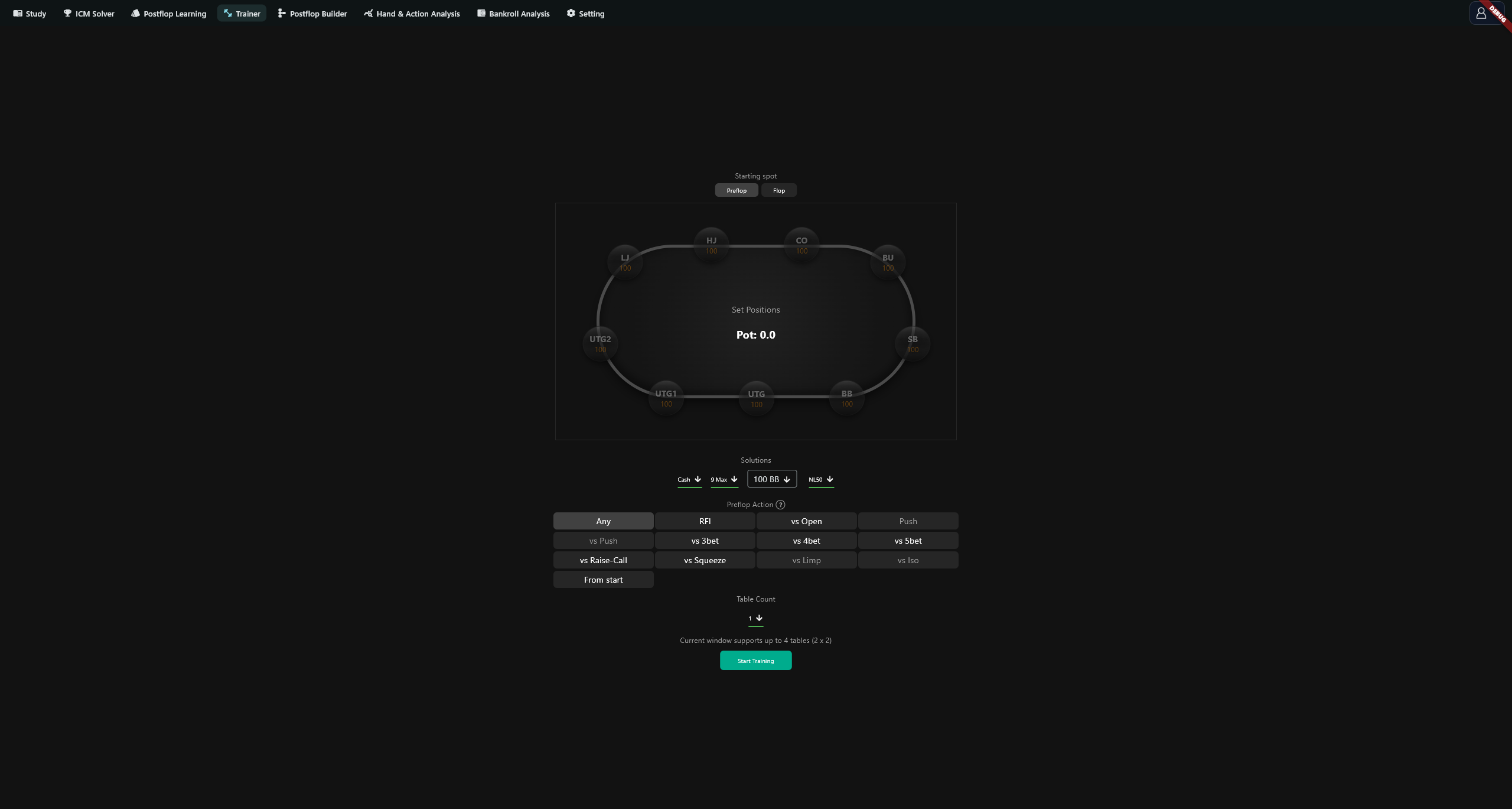
The line determines where a decision starts. RFI is an unopened pot; vs Open faces an opening raise; vs Limp faces another player's limp; vs Iso faces an isolation raise after your limp. From Start begins at the start of the hand. Other choices include Any, Push, vs Push, vs 3bet/4bet/5bet, vs Raise Call and vs Squeeze.
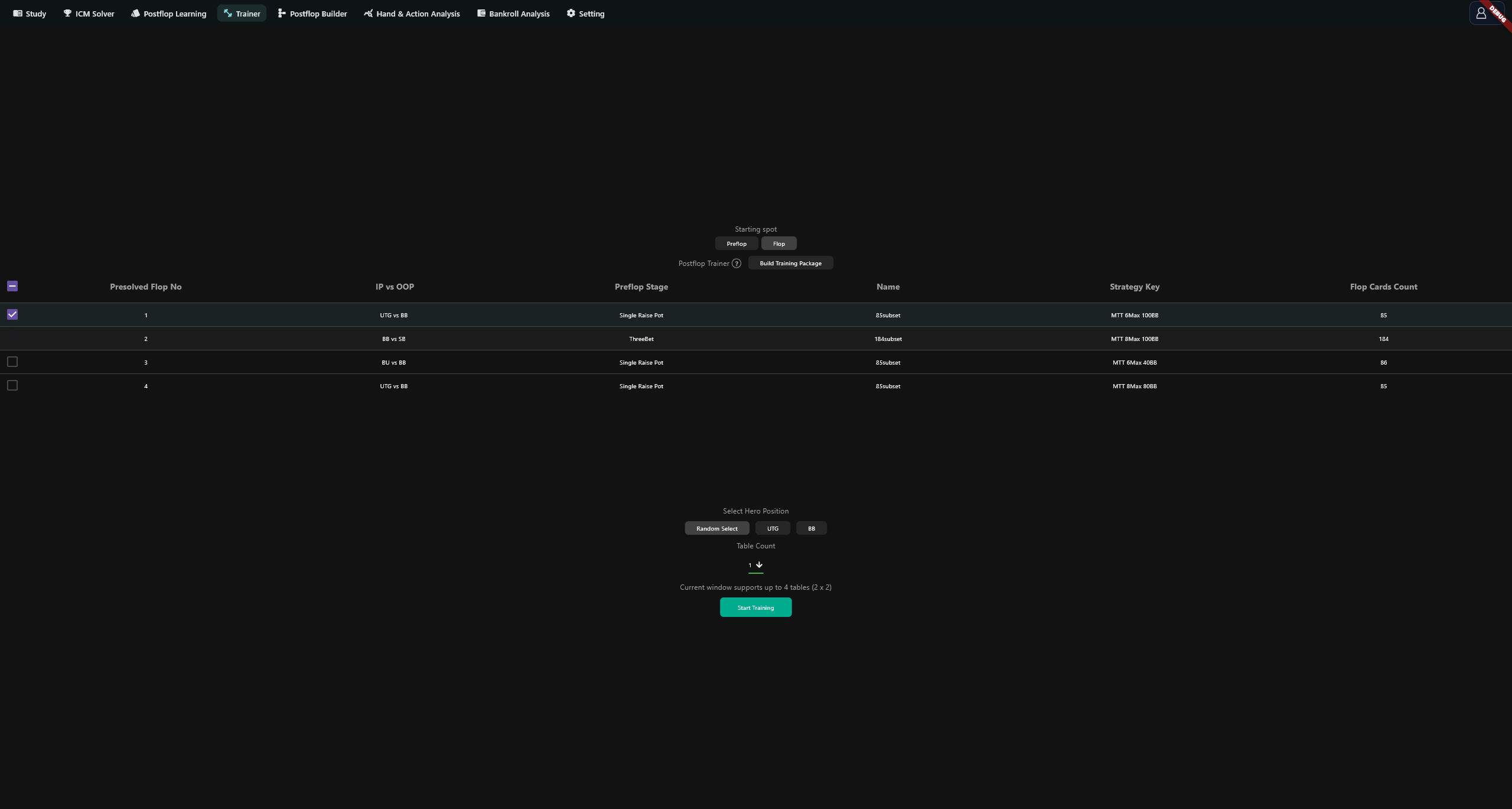
For postflop practice, select one or more packages. With one package, choose a Hero side or Random; with multiple packages, positions are randomized. Table Count defaults to 1 and is limited by the space available in the window, up to 8 tables.
Practise and end a session
Select Start Training. Action amounts use BB. To change the configuration, first select End Training. After deciding, inspect the recommended frequencies and explanation. Click the timeline to review an earlier node, then Continue to resume.
Automatic dealing is off by default. When enabled, qualifying hands scoring at least 80 continue automatically. Postflop has a three-second countdown; manual interaction cancels that countdown.
Ending training clears current-session statistics and retains history. If the interface stops responding, end and restart the session. For a repeated problem, record the board, line and last action; do not change a poker decision merely to advance the interface.
Review a hand
Postflop settlement offers the next hand, Study and replay. Street buttons jump to Hero's first action on that street; previous and next controls step through decisions. Preflop settlement continues to the next hand.
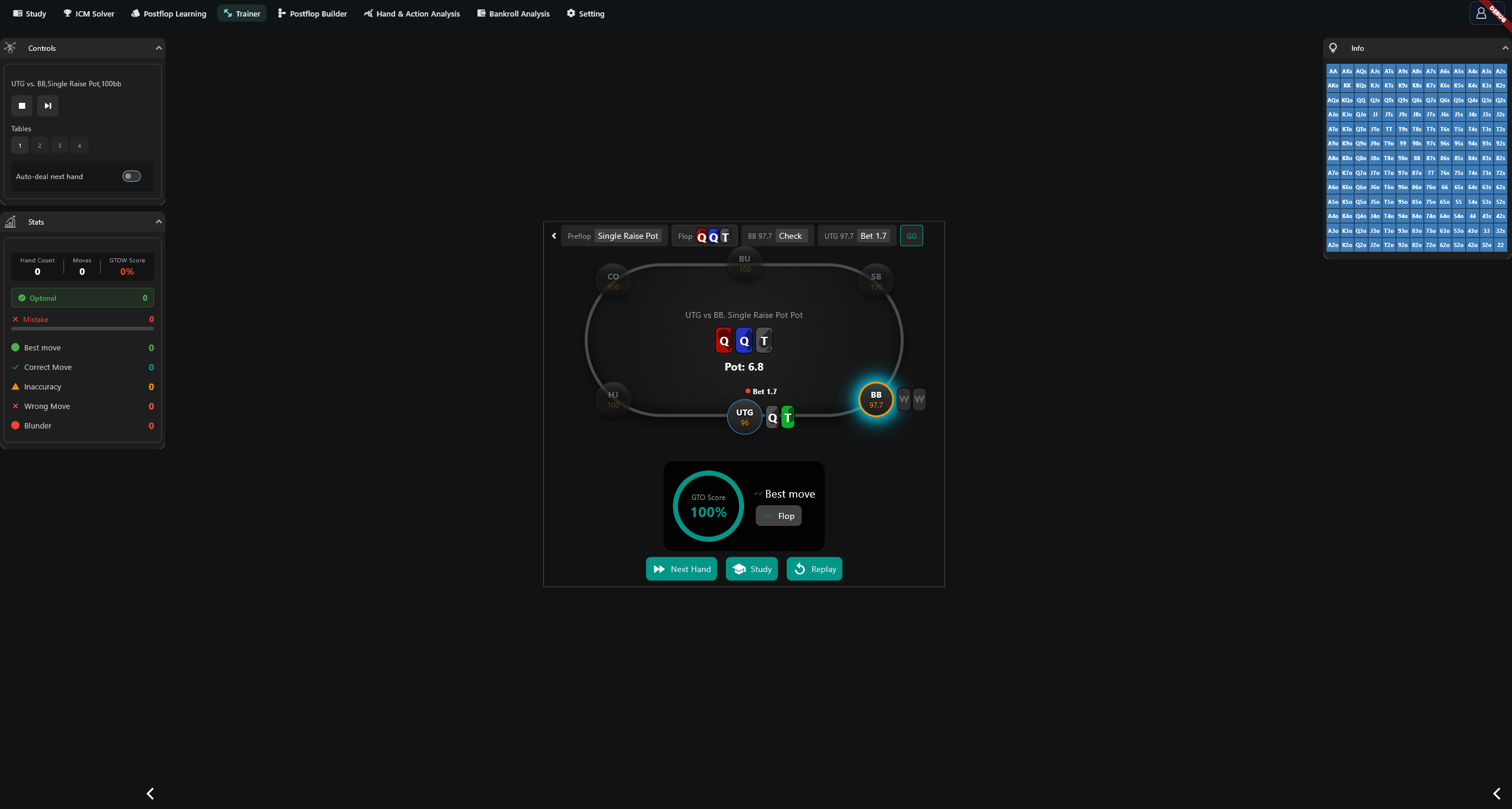
Compare your selected action with its recommended frequency, then inspect EV. A low-frequency action can still belong to a mixed strategy. The score primarily measures frequency matching; it is not profit or EV loss.
Understand scores and sampling
| Score | Calculation |
|---|---|
| Action | Most frequent action: 100. Other nonzero action: selected frequency ÷ highest frequency × 100. Zero-frequency action: −100 |
| Missing preflop frequency data | Fold / Check: 100; other actions: −100 |
| Hand | Average of Hero's action scores; no actions: 0; an invalid action ending the hand: −100 |
| Session | Sum of hand scores ÷ hands, rather than action count |
Hand grades are Optimal at 95 or above, Correct from 60 to below 95, Inaccuracy from 20 to below 60, Wrong Move above −60 to below 20, and Blunder at −60 or below. Individual actions have a separate frequency/EV grade. Preflop actions do not produce Wrong Move. For a zero-frequency postflop action, negative action EV produces Blunder; otherwise it produces Wrong Move.
History increases the sampling weight of weaker results. For an existing record, the updated score is 0.6 × new score + 0.4 × previous score; sampling weight is 110 − historical score. Preflop records use the 169 starting-hand classes; postflop records use boards within each package. This does not guarantee that the lowest-scoring item appears next.
Line availability
Push lines require a selected minimum depth of 17 BB or less. RFI / vs Open require a maximum depth of at least 20 BB; 3bet / Squeeze / Raise Call lines require 30 BB; 4bet requires 80 BB. 5bet requires at least 100 BB and either an 8/9-player table or Cash. Limp lines also depend on a depth of at least 20 BB, positions and support in the selected library.
Troubleshooting
After a preflop download failure, check Solutions before continuing with a previously loaded strategy. For an empty postflop package list, check that a package contains a solved flop and that the data root is correct. For missing lines, check the availability conditions, positions and stack depths.