
Set up and compare ICM postflop strategies
Enter payouts, stacks and a preflop line, then compare ICM and chipEV solutions for the same spot.
On this page
Gather the tournament details
Open ICM Postflop Solver from the navigation. Have the payout structure, players' starting stacks, blinds and ante ready. Bubble and two-table scenarios also need the remaining field size and off-table stacks. The preset menu at the top right can load templates or save and delete your scenarios.
Preflop ranges come from chipEV libraries. ICM applies to the postflop solve; entering payouts does not turn those library ranges into ICM preflop ranges.
Set up players and the preflop line
Scenario, stacks and payouts
Choose a final-table, bubble, final-table bubble or two-table scenario. Changing scenarios replaces the payout table after confirmation.
Enter the big blind, ante and stack units. Choose 2–9 players, enter positive stacks and mark Hero. The action line determines OOP and IP.
Enter payout amounts or percentages. Percentages must total 100%, within ±0.01.
For KO formats, enter the prize-pool/bounty split and player bounties. PKO also uses the immediate cash percentage, which defaults to 50.
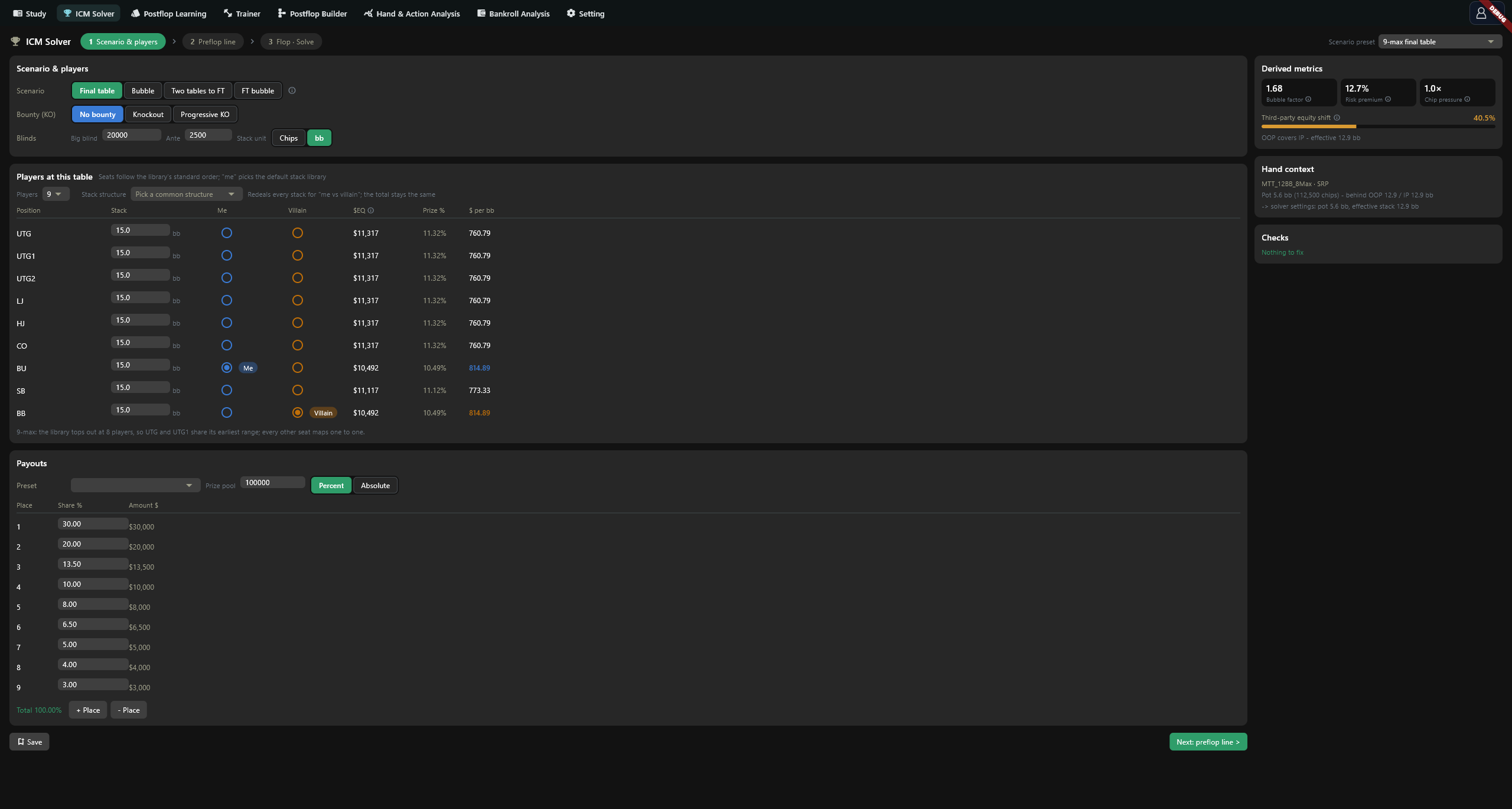
The preflop effective-stack setting selects the library depth. Changing it resets the line and ranges. A nine-player table uses an eight-player library, with UTG and UTG1 sharing its earliest-position range. Above 16 players, ICM uses a bucketed approximation.
Choose a pot type and ranges
| Pot | Line to enter |
|---|---|
| SRP | Opener, raise-to amount and a caller acting after the opener |
| 3-bet | Opener and 3-bettor with their sizes, followed by the opener's call |
| 4-bet | Open, 3-bet, 4-bet and call; both players need at least 80 BB effective before the hand |
| Limp | SB limp and BB check, using a withLimp library |
Default 3-bets are 3 times the open in position or 3.5 times from SB/BB. The default 4-bet is 2.3 times the 3-bet. Editing sizes updates the pot, remaining stacks and positions.
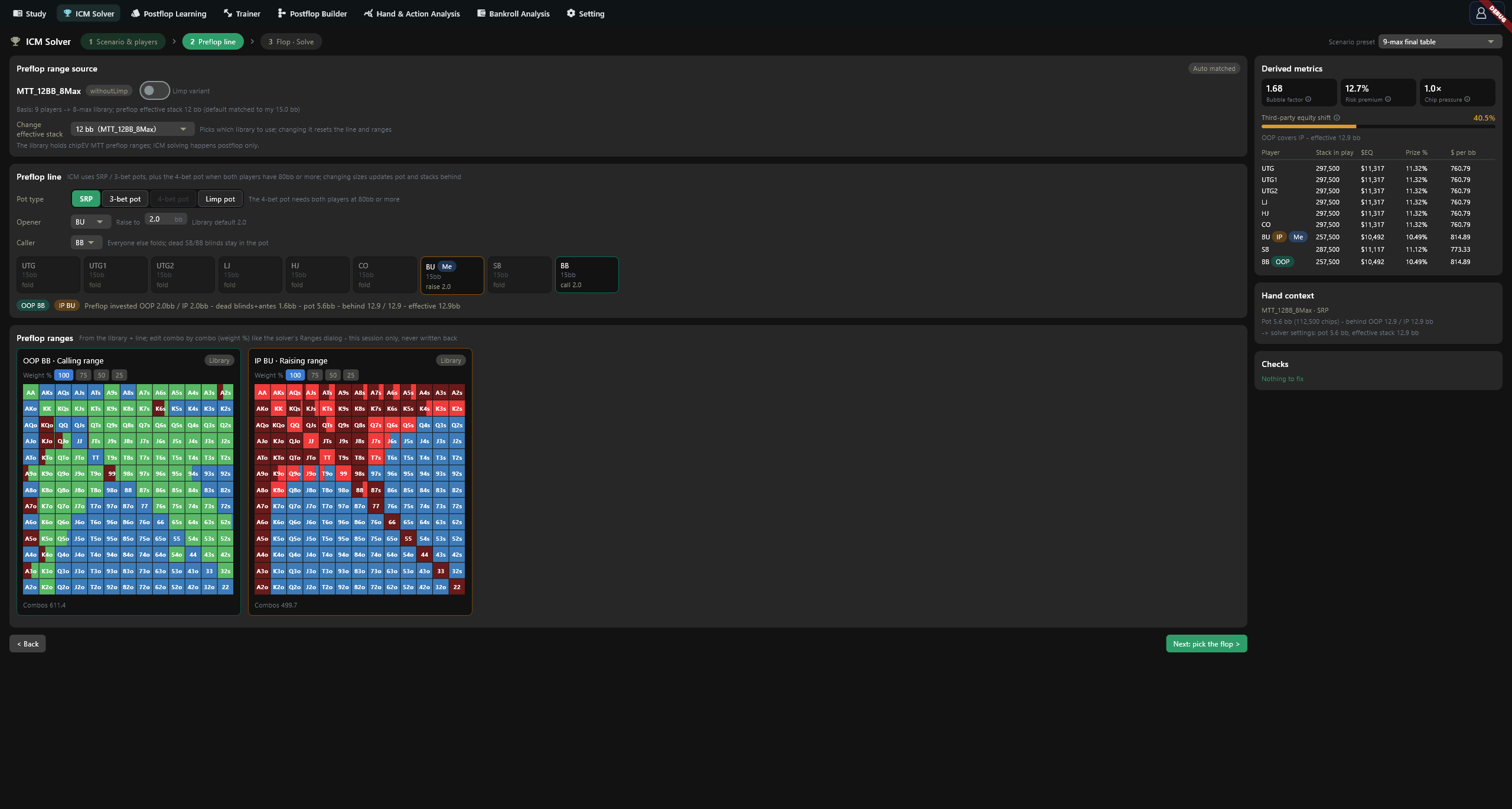
Once the line is complete, inspect the OOP/IP range matrices and combination counts. Edit range… changes combination weights for this solve without changing the library. A warning appears when actual effective stacks differ from the library depth by more than 25%.
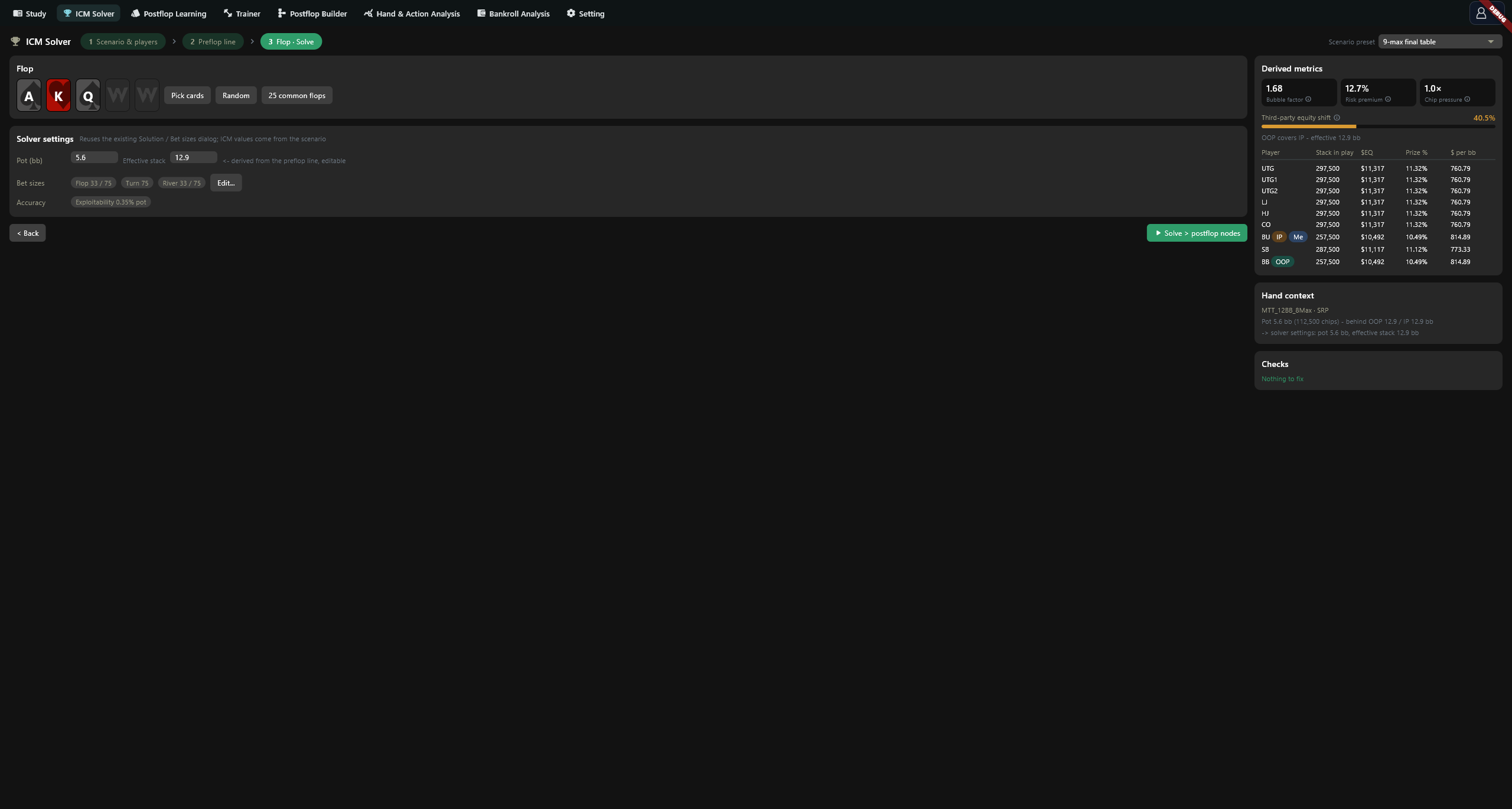
Choose a flop and solve
Select three cards using the picker, random selection or the common 25-flop set. Check the derived pot and effective stack. You can edit them and restore the automatic values; the effective stack cannot exceed either player's remaining stack.
Edit bet sizes if needed, then start the solve. ICM runs first, followed automatically by chipEV. Wait for chipEV to finish before selecting it or opening the comparison.
Compare the solutions
The result page contains action nodes, a strategy matrix and details. Once chipEV completes, select the comparison manually. Both sides follow the same node and turn/river cards.
| View | What it shows |
|---|---|
| Split cells | ICM on the left half of each cell; chipEV on the right |
| Side by side | A full matrix for each solution |
| Difference heatmap | Bet-plus-all-in frequency changes: blue means lower under ICM, red means higher |
| Hand | Actions, both frequencies, their difference and EV |
| Comparison summary | Overall changes in aggression, all-ins and average sizing, followed by category details |
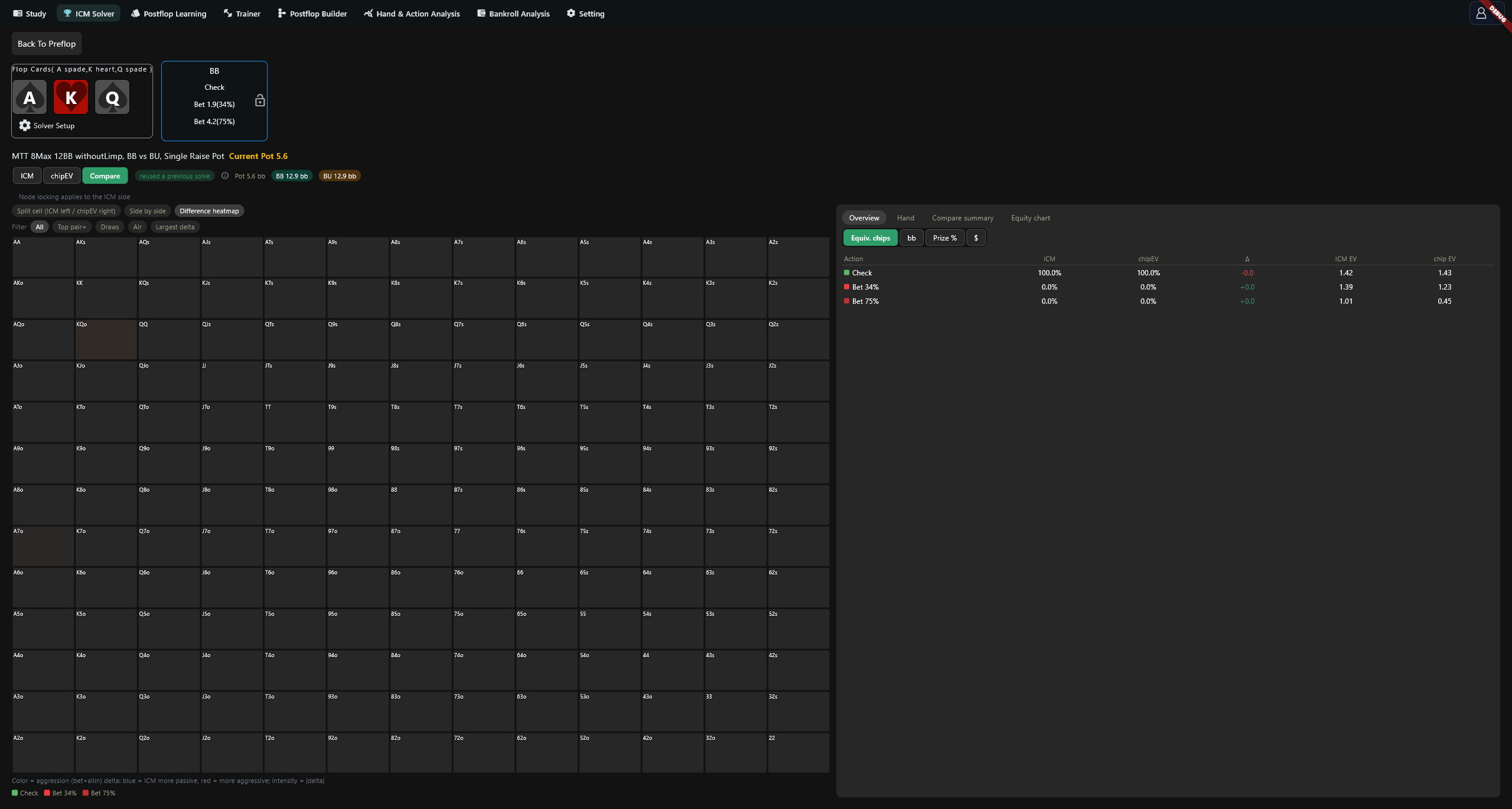
Differences describe the solutions under the current inputs. There is no universal cutoff for ignoring a difference or judging a strategy. The EV column uses the ICM result; available units include equivalent chips, BB, prize-pool percentage and money. Each side has its own equity chart. Missing equity data is not zero equity.
A node lock changes only the side you lock. Include that difference in assumptions when comparing the results.
Solver parameters
The ICM solve uses zero rake. The default exploitability target is 0.35% of the pot. The pot must be positive, and payouts, remaining players and off-table player counts must agree.
Payout equity and risk premium
$EQ estimates payout equity from the chips still on the table and the payout structure. Dollars per 1,000 chips or per BB expresses its unit value. Table stacks exclude chips already posted or invested in this hand.
Bubble Factor compares the payout-equity effect of losing and winning chips. For an even-money example, BF=1.5 gives a risk premium of (BF−1)÷(2×(BF+1))=10%, implying a 60% equity threshold. That threshold does not apply unchanged to other pot odds.
Bucketed calculations combine off-table players. Their $EQ values are approximations, not cash you can claim. Changes in uninvolved players' equity do not, by themselves, determine whether to fold.
Solve and comparison problems
| Problem | What to check |
|---|---|
| Hero is missing or absent from the line | Check the selected player and the positions in the line |
| Payout or player totals do not match | Check totals, field size and off-table players |
| Effective stack exceeds remaining stacks | Reduce the manual value or restore the automatic value |
| The line is already all-in preflop | Check raise sizes against starting stacks |
| No range for this line | Choose another line or matching library |
| chipEV is unavailable | Wait for completion; if it fails, the completed ICM result remains available |